
SH2-132 - The Lion Nebula
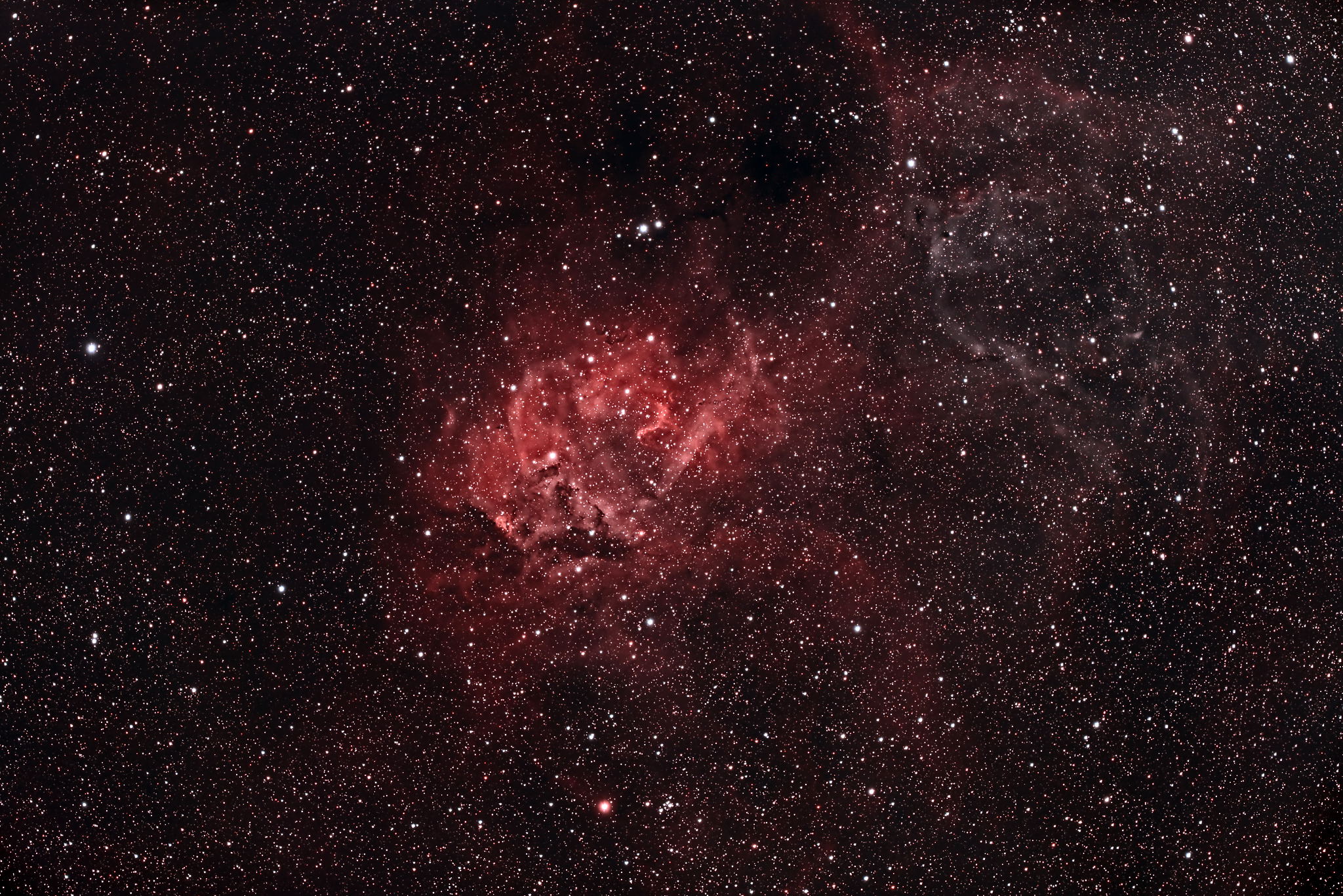
Photo by Matthew Ryno
Scope / Lens
Vixen AX103s Quad APO Refractor
Camera
ASI-294MC-Pro
Description
Processed 5 hours of data taken in the backyard in Cudahy on a June night with my refractor. Light pollution remains oh so subtle in wispy corners of the image, as this was captured in the middle of the city in Bortle 8. But it is still enjoyable to take in the view from my refractor and really get to know this area of the sky -This is a crowded window of a distant landscape of galaxies and a bustling foreground mixed with our own Milky Way stars, a star cluster just 5,000 light years away, and the faint smudge of another galaxy like a needle in the haystack hidden in the image millions of light years away.
This 15-hour data integration from my backyard in October looks into the depths of the Perseus Arm, the Lion Nebula (Sh2-132), which is a vast star-forming emission nebula complex 10,000 light-years away in the constellation Cepheus. The deep reds (H-alpha) energized hydrogen makes up the "bulk" of the nebula, including the flowing ridges and the long "tail" extending toward the right. Notice the dark, opaque patches scattered throughout the bright red regions. These are dark absorption nebulae. The "voids" in the red glow (like LDN 1154 and 1150) aren't empty space-they are dense, cold clouds of cosmic dust silhouetted against the bright background, acting as the nebula's skeletal structure. The "head" of the Lion (the brighter complex in the center-left) features sharp edges where stellar winds are carving into the surrounding gas, creating gas structures where future star systems may be forming.
Working through my fall 2025 backlog, this time from data captured in my Bortle 8 city backyard during a clear time in October and November in Wisconsin.
ID: 1642